Innovation Ecosystems: From Concept to Global Scalability
28 stycznia 2026
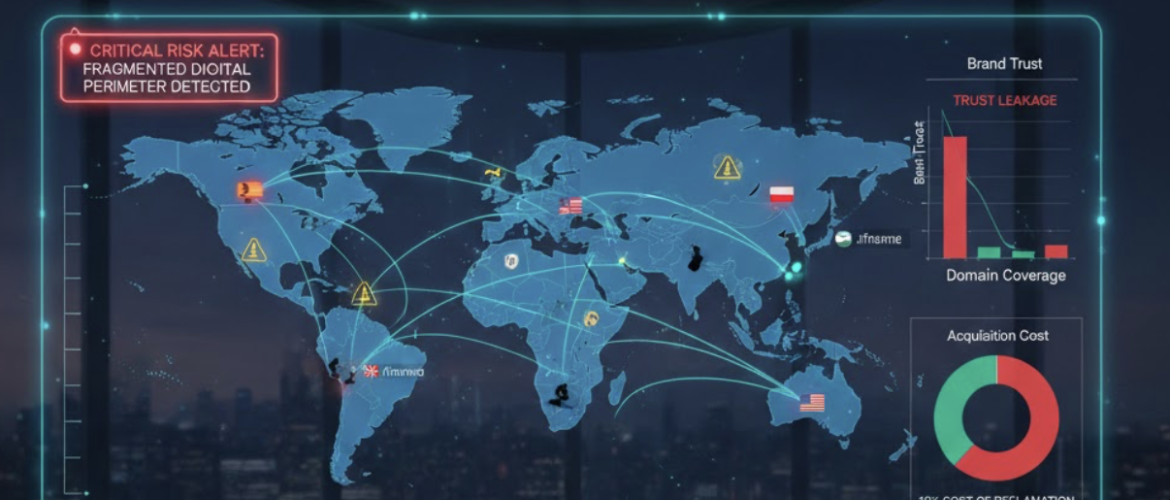
The Concept of "Digital Perimeter" In 2026, the security of a global enterprise is no longer just about firewalls and encryption. It is about the "Digital Perimeter"—the complete ownership of a brand's identity across all strategic jurisdictions. For a global giant, the absence of even a single key national or sectoral domain is not just a missed opportunity; it is a structural vulnerability.
The Multi-Vector Risk of Domain Fragmentation When a corporation fails to secure a "Must-Have" portfolio, it opens itself to three critical risks:
Jurisdictional Displacement: If a competitor or a third party controls your brand on a .finance, .io, or a major national TLD like .in or .us, they effectively control your entry into that market. The cost of reclaiming these assets via legal arbitration is often ten times the cost of early acquisition.
The Trust Leak: In a world of automated transactions, users expect a brand to reside on its native TLD. A Polish customer expects .pl, an Italian customer expects .it, and a financial partner expects .finance. Any deviation creates "friction," which in 2026 leads to immediate loss of conversion and brand trust.
Governance and Compliance Gaps: Regulators in various regions now increasingly look at "digital presence" as a sign of local commitment. Lacking the proper regional domain can complicate licensing and compliance in highly regulated sectors like Fintech or AI.
Auditing the Giants Recent market audits of the world's leading tech companies reveal a startling truth: many billion-dollar entities are operating with "leaky" portfolios. They possess the .com, but remain vulnerable on emerging TLDs and key regional extensions. In the high-stakes environment of 2026, this is considered a failure of board-level due diligence. A "clean" portfolio is now a prerequisite for any major M&A (Mergers & Acquisitions) activity or sovereign investment.
Conclusion: Sovereignty as a Strategy Digital sovereignty is not a luxury; it is a defensive necessity. For any company aiming for global leadership, securing the full spectrum of its digital identity is the first step in risk mitigation. In 2026, the companies that thrive will be those that treat their domain infrastructure as the bedrock of their global security.